

Anger Is Not the Problem: What It Is Actually Covering
Written by Evan Vukets, RCC, Registered Clinical Counsellor in Abbotsford, BC. I support men in Abbotsford, the Fraser Valley, and online across BC. Learn more about me.

Most conversations about anger start in the wrong place.
They start with the explosion. The thing that was said, the way someone reacted, the damage that followed. And from there, the focus tends to go straight to management. How to cool down faster, how to walk away before it gets worse, and how to stop doing the thing that keeps causing problems.
Those are not useless conversations, but they do not start with the equally important context. The focus on the explosion assumes it exists in isolation to the rest of life. But Anger is a signal and like most signals, what matters is not the signal itself but what it is pointing to.
In my work with men in Abbotsford and across the Fraser Valley, this is one of the most important reframes I work through with clients. Not because it lets anyone off the hook for how their anger affects the people around them, but because understanding what is underneath it is the only way to actually change the pattern rather than just manage it.
Anger as a Secondary Emotion
There is a concept in psychology that is useful to understand without needing to overcomplicate it. Anger is often described as a secondary emotion. What that means is that something else usually comes first.
Hurt.
Fear.
Shame.
Feeling disrespected.
Feeling powerless.
Feeling like you do not matter.
These are often the primary emotions, the ones that arrive first and sit closest to the real experience. Anger tends to follow them, and often it follows them so quickly we loose sight of what made us angy.
Clinically, the reason why anger being seen as a 'secondary emotion' is important because when someone is only ever working on the anger itself, they are working on the last layer of something that started several layers down. You can get reasonably good at not reacting, and still have no idea what you were actually feeling. But at best, anger management can feel like whack-a-mole.
The feelings wheel (diagram below) is a tool I use with clients for exactly this reason. It starts with broad categories like anger, fear, sadness, and disgust, and then branches outward into more specific emotions. When a man looks at the wheel and works outward from the word anger, he often finds something he did not expect. Disrespected. Embarrassed. Jealous. Helpless. Betrayed. Those words carry different information than anger does, and they point toward different conversations.
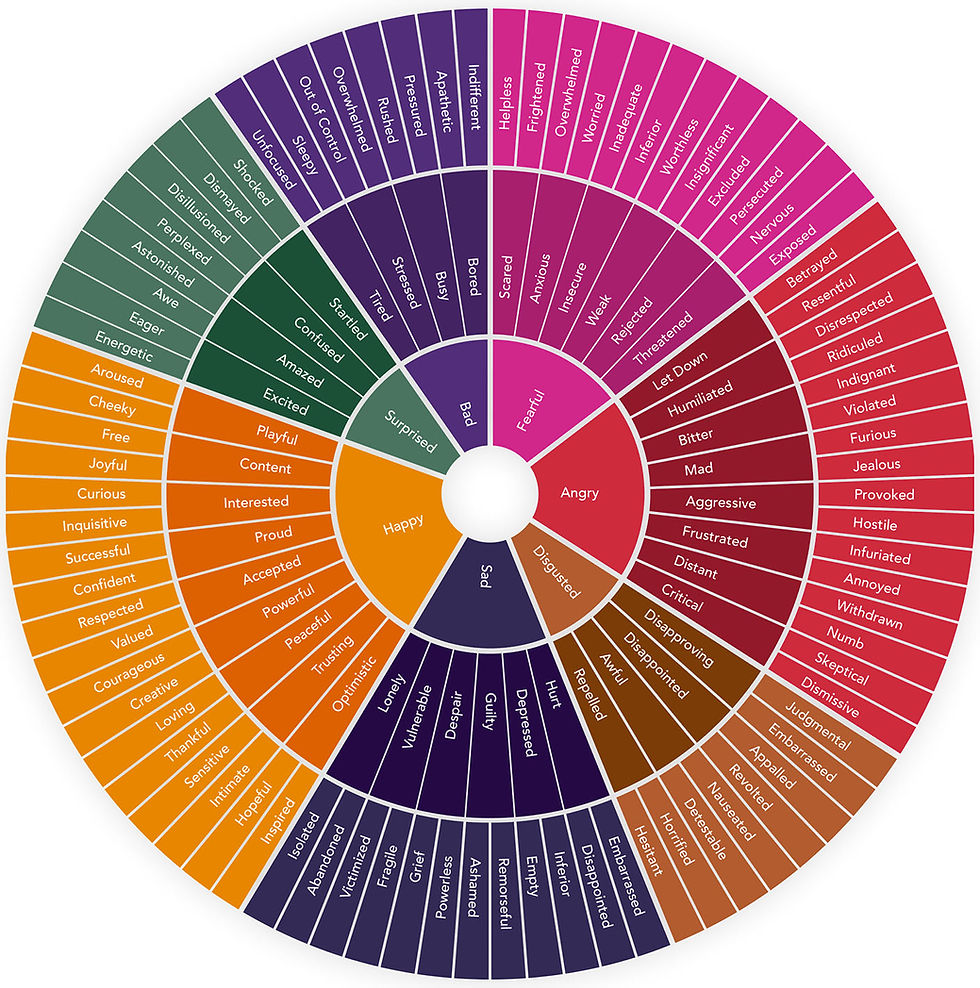
If you have not come across the feelings wheel before, the post on expanding your emotional vocabulary beyond mad, sad, and glad is a good place to start.
Why Anger Gets to the Surface First
There is a reason anger tends to be the emotion that makes it through, even when something else started the process.
Anger feels like movement. It comes with energy, with a sense of forward motion, with the feeling that something is being done rather than endured. The emotions underneath it, hurt, fear, shame, tend to feel like the opposite. Vulnerable. Exposed. Stuck. For a lot of men, those feelings were never modelled as acceptable, let alone useful. You learned early that showing hurt made you a target, that admitting fear was weakness, that shame was something to bury rather than name.
So the system adapts. The primary emotion arrives, gets registered somewhere below the surface, and anger shows up to cover it. Often this is not even done through a conscious choice. Just through years of the same pattern running until it became automatic.
This connects to something I wrote about in the post on why men struggle to identify their emotions. When the pathway between feeling something and naming it clearly has never been well developed, anger tends to fill the space. It is available. It is familiar. It does not require the same kind of exposure that naming hurt or fear does.
What That Looks Like in Practice
The man who explodes when his partner questions a decision he made may not primarily be angry about the question. He may feel undermined. Like his judgment does not get trusted. Like no matter what he does it is not enough.
The man who goes cold and silent after a conflict may not be indifferent. He may be flooded, overwhelmed, or sitting in shame about something he cannot find the words for yet. Anger turned inward tends to look like withdrawal rather than explosion, but the mechanism is the same. Something underneath did not get expressed and the system shut down to protect itself.
The man who snaps at his kids over something small at the end of a long day is rarely actually angry about the small thing. He is carrying a weight that has been building, and the small thing was the last step of a climb that started much earlier. I wrote about that escalation process in detail in the Anger Mountain post, which is worth reading alongside this one because the two are connected. The mountain explains the cycle. This post explains what is running underneath it.

The Shame Loop
One pattern worth naming specifically is the relationship between anger and shame, because it is one of the most common things I see and one of the least talked about.
Shame tends to produce one of two responses. Some people go small, withdraw, and disappear. Others go large, get defensive, and push outward. For many men, the second response has been reinforced for so long that it runs automatically. Something triggers a moment of shame, perceived failure, embarrassment, being called out in front of others, feeling like you let someone down, and before the shame has even been consciously registered, anger is already moving.
Anger serves a function with shame, it protects against the exposure of it. Anger redirects the energy outward so the internal experience does not have to be felt directly. While it may work to alleviate shame in the moment, with it comes the guilt and regret of the post-crisis phase, which I described in the Anger Mountain as the 'emotional hangover.' That guilt often contains shame of its own, about the anger itself, and the cycle runs again.
Anger covers shame. Then the anger produces more shame. Then that shame produces more anger. Without understanding what is happening underneath, the loop just keeps tightening.
This Is Not About Excusing the Impact
It is worth being direct about something.
Understanding that anger is a secondary emotion, and that hurt or shame or fear is usually underneath it, does not change the impact that anger has on the people in the room. A partner who has been on the receiving end of repeated explosions does not experience it as hurt expressing itself imperfectly. They experience it as anger. The kids in the house do not know what dad is carrying. They know what the house feels like when he is in it.
Understanding the mechanism matters because it changes how the work gets done, not because it explains away the responsibility for how it lands. The 4 Horsemen post is relevant here because contempt, defensiveness, criticism, and stonewalling are often what the people on the receiving end of poorly managed anger start to develop over time. By the time that pattern is running in a relationship, the original emotion underneath the anger is buried under several layers of damage that have accumulated on both sides.
Getting to What Is Underneath
The work is not complicated to describe, even if it takes time to do. It is learning to slow down enough, before or after the peak, to ask a more honest question than why am I angry, questions like:
What happened right before the anger arrived?
What did that moment mean?
Did it feel like disrespect, or rejection, or failure?
Was there something at stake that did not get named?
Is this feeling familiar, something that has shown up in similar moments before?
Those questions are not easy to sit with, especially in the middle of a hard moment. That is part of why building the vocabulary outside of conflict matters so much. The post on why men say I don't know during hard conversations speaks to this directly. The blank that shows up when someone asks what you are feeling is often not indifference. It is a vocabulary that was never built for this kind of question. The feelings wheel, practiced when things are calm, starts to change that.
Anger Management Counselling in Abbotsford
The goal of anger management counselling is not to produce a man who never gets angry. Anger is a normal, human emotion. It is telling you something real. The goal is to understand what it is telling you clearly enough that you can respond to that rather than just to the anger itself.
That is different from most anger management programs, which focus primarily on the peak and the behaviour. What I work on with men in Abbotsford and online across BC is the full picture: the baseline, the escalation, the primary emotions underneath, and the patterns that have formed around all of it. The Anger Mountain worksheet is one tool that supports that work between sessions.
If you are looking for anger management counselling in Abbotsford or online across BC, a free consultation is a straightforward place to start. You do not need to have it figured out before you come in. You just need to be willing to look at what is actually going on underneath.
Common Questions About Anger and What It Covers
What does it mean that anger is a secondary emotion?
It means something else usually comes first. Hurt, fear, shame, or feeling disrespected tend to arrive before anger does. Anger follows quickly enough that the gap is hard to notice, but understanding what came first is what makes the work more effective than just managing the surface behaviour.
Why do men struggle to identify what is underneath anger?
For many men, the emotions underneath anger, particularly hurt, fear, and shame, were never modelled as acceptable or useful. Anger became the default because it felt like movement and did not carry the same exposure. Over time that pattern becomes automatic. The post on why men struggle to identify their emotions goes deeper on this.
What is the shame and anger loop?
Shame tends to trigger anger as a protective response. The anger then produces guilt and regret, which carries its own shame, which can trigger more anger. Without understanding the cycle, it keeps running. Understanding what is underneath is how the loop starts to break.
Does understanding the cause excuse the impact?
No. Understanding that hurt or shame is underneath anger does not change how it lands on the people around you. The work is about understanding the mechanism so the pattern can actually change, not about explaining it away.
How is anger management counselling in Abbotsford different from anger management programs?
Most anger management programs focus on behaviour at the peak. Counselling works on the full picture: the baseline stress, the escalation cycle, the primary emotions underneath, and the relational patterns that have formed over time. If you are looking for anger management support in Abbotsford or the Fraser Valley, a free consultation is available at Evan Vukets Counselling.


Comments