

Why Men Struggle to Identify Their Emotions
Updated: Mar 30
Written by Evan Vukets, RCC, Registered Clinical Counsellor in Abbotsford, BC. I support men in Abbotsford, the Fraser Valley, and online across BC. Learn more about me.

A question many counsellors ask almost out of default from training is a simple one:
“What are you feeling right now?”
From my years of specializing in men's mental health, I have learned it is not always the most useful question, and it is not unusual for the room to go quiet when it is asked.
Eventually the answer comes, something along the lines of "fine" or if more honestly shared it is “I don’t know.”
For many men this is not avoidance or resistance to why they struggle to identify emotions. It is confusion. They know something is happening internally, but they cannot quite name it. They may feel tension in their body, restlessness in their mind, or a sense that something is off. Yet when asked to describe the emotion behind it, the words are difficult to find.
There is actually a psychological term for this experience: alexithymia.
Alexithymia is a psychological term that describes difficulty identifying, understanding, and describing one's emotions.
Most people have never heard the word before. But the experience behind it is far more common than we might think.
What Is Alexithymia and Why Do Some men struggle to identify emotions
Alexithymia is a psychological term used to describe difficulty identifying and describing emotions.
Someone experiencing alexithymia might struggle to answer questions like:
What am I feeling right now?
Why did that situation bother me?
What emotion is underneath this reaction?
Instead of describing emotions, the person may focus on physical sensations or practical concerns. They might say they feel tired, stressed, or irritated, without being able to connect those experiences to deeper emotional states like disappointment, sadness, shame, or hurt.
It is important to say that not all men experience alexithymia. Many men have strong emotional awareness and communicate their feelings clearly.
However, it is also true that many men were not taught how to develop this skill growing up. Emotional awareness is something that is often learned through modelling, conversation, and practice. When those experiences are limited, it can take longer to develop the language and awareness needed to recognize what is happening internally.
The Socialization of Doing and Fixing
Many men are raised with a strong orientation toward doing, solving, and fixing.
From an early age boys often receive messages that competence, action, and problem solving are the appropriate responses to difficulty. When something is broken, the task is to repair it. When a challenge appears, the goal is to overcome it.
This mindset can be incredibly valuable. It fuels persistence, creativity, and responsibility.
However, it can also leave men somewhat ill equipped for experiences that cannot be solved like a problem.
Emotions do not always respond to fixing. They require noticing, tolerating, and understanding before they can shift. When someone has been trained primarily in action and problem solving, the quieter skill of emotional awareness can feel unfamiliar.
In many ways, men are taught how to move, but not always how to sit with what is happening inside them.

Why Anger Often Becomes the Default Emotion
One emotion that many men recognize quickly is anger.
Part of the reason for this is that anger carries a sense of movement. It energizes the body. It pushes someone toward action. It provides direction.
In contrast, emotions like sadness, disappointment, or shame often ask for stillness and reflection. They do not offer immediate solutions or a clear path forward.
Because anger contains energy and movement, it can feel more familiar and even more comfortable than other emotional states. This does not mean anger is always destructive or wrong. Anger can signal that a boundary has been crossed or that something important needs attention.
However, anger is often what psychologists call a secondary emotion.
This means it can sit on top of other feelings.
Under anger there may be:
hurt
embarrassment
disappointment
feeling dismissed
feeling overwhelmed
fear of failure
When those underlying emotions remain unrecognized, anger becomes the emotion that surfaces most clearly.
High Functioning but Emotionally Uncertain
Many of the men who experience this difficulty are high functioning in nearly every other area of life.
They are working, providing, solving problems, and meeting responsibilities. In many professions decisions must be made quickly, problems solved efficiently, and outcomes delivered. Over time this mindset can become something like a “work brain.” A way of thinking built around action, speed, and practical solutions.
That approach can be incredibly effective at work. But unfortunately if we were to compair it to a tool in a toolbox it would be a sledgehammer. On a demolition site it is the perfect tool, but much less perfect when trying to build a birdhouse or be present with the family. Relationships, conversations, and family life rarely respond to force and efficiency.
I have worked with many men who had became so very skilled with the sledgehammer that they found their worth in it, which made them believe they were unable to put it down. Longer hours at work only compounded current and created more problems in their lives.
When the only tool available is action, it becomes much harder to notice what is happening emotionally underneath it.
Learning Emotional Awareness
The encouraging part of this conversation is that emotional awareness is a skill, and like most skills it can be learned.
One tool many therapists use to support this process is something called a feelings wheel.
A feelings wheel organizes emotions into categories and shows how broad emotions branch into more specific ones. For example, a general emotion like anger might connect to more precise experiences such as humiliated, withdrawn, provoked, or resentful.
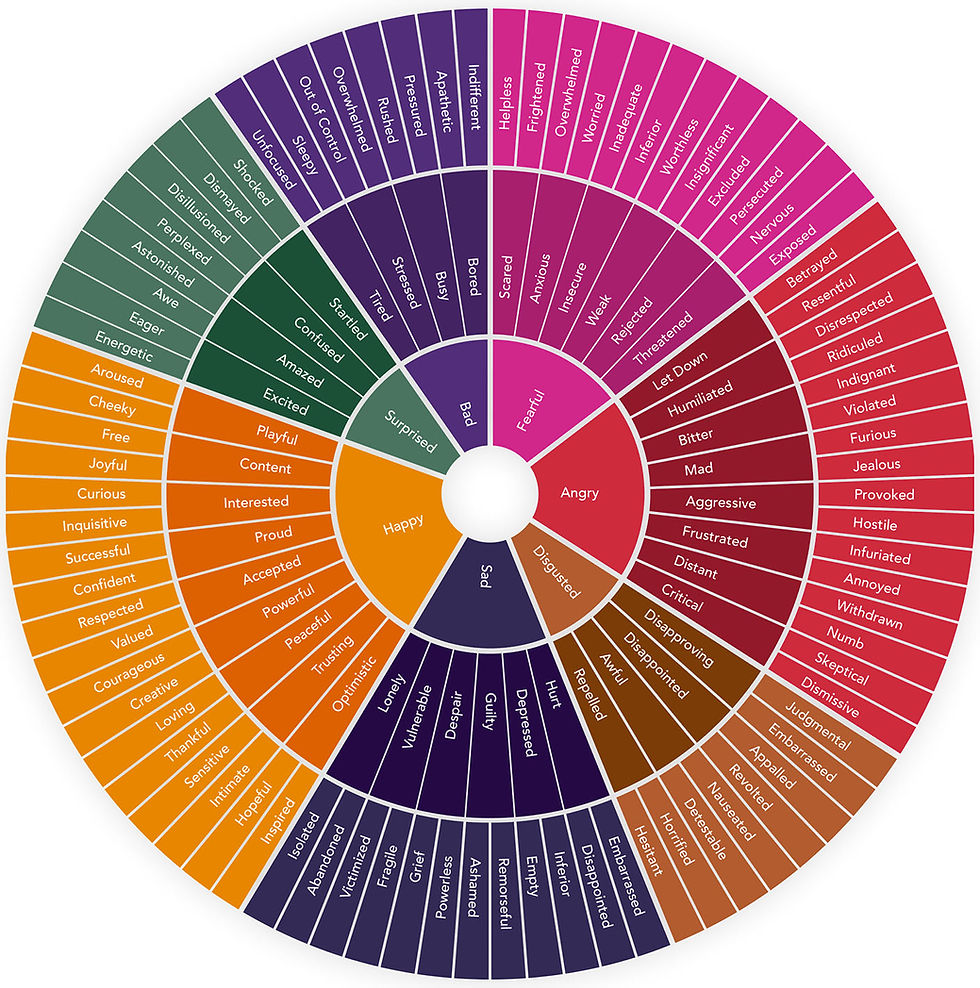
Looking at a feelings wheel can help people move from a vague sense that something feels wrong toward a clearer understanding of what might be happening emotionally.
If anger shows up frequently, it can sometimes be helpful to pause and ask a few reflective questions:
What might be underneath this reaction?
Did something happen that left me feeling dismissed or unappreciated?
Am I actually feeling overwhelmed or disappointed?
These questions are not about judging the emotion. They are about becoming curious about what it might be pointing to.
Over time, this curiosity begins to build a more detailed emotional vocabulary. If this sounds like a tool that could be useful for you, I went over it in more detail in a previous post, Beyond Mad, Sad, and Glad: Why it is important for Men to Learn emotional awareness.
A Different Way of Thinking About Emotions
For many men, developing emotional awareness is not about becoming someone different or abandoning the strengths that come with problem solving and action.
It is more like adding another tool to the toolbox.
The ability to notice and name emotions can make it easier to navigate stress, communicate in relationships, and understand reactions that might otherwise feel confusing.
Most men are not lacking emotions. More often, they were simply never taught how to recognize and describe them.
And like many things that were not learned earlier, that understanding can still develop later with the right space, reflection, and conversation. If this post resonated with you, I encourage you to book a free consultation. Or if you think someone in your life may benefit from it, please feel free to share!


Comments